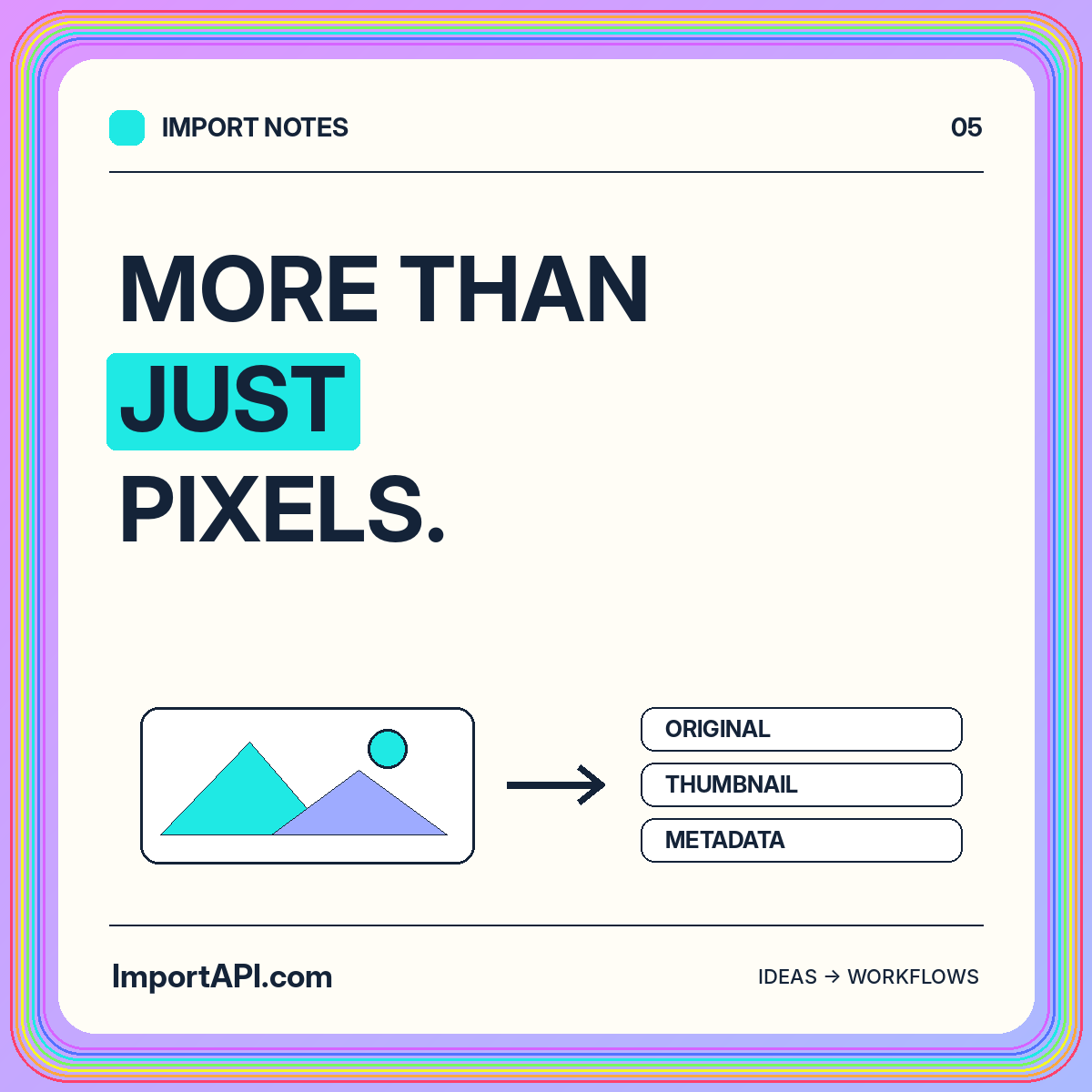
More than pixels. Better media records.
Connect original images, descriptive metadata, derivatives, and publication review in a maintainable product-image library.
Read the guideGOOD DATA. GREAT POSSIBILITIES.
Build an image import around the asset record, not just its filename. Explore format decisions, verified metadata, derivatives, and meaningful descriptions.
Separate the creative asset, its original file, and its generated variants. Use stable asset identifiers and keep product associations explicit. Choose a deliberate set of formats and inspect accepted files through an appropriately controlled processing path.
A supplied filename or content type is not proof of file content. Keep invalid files distinct from valid formats that your workflow does not accept.
Keep originals separate from thumbnails and editorial crops when your retention policy allows. Record output dimensions and the transformation version. Test orientation handling and inspect diagrams or labels before applying automated cropping.
A square product tile and a wide editorial image can be legitimate variants of the same asset. Store that relationship rather than relying on names such as final-v2.
Decide what embedded metadata belongs in public output. Preserve useful provenance in a protected record when public derivatives exclude it. Write descriptions for their page context instead of publishing camera-generated filenames.
Separate inspection from publication approval. Test replacement, duplicate handling, and deletion so retiring one image does not unexpectedly break other references.
Use a small, representative source and write down the expected result for one accepted record, one correction, and one repeated attempt. Keep the original values and the destination expectations visible throughout the review.
Use the format guides for source decisions and the local quickstart to see a simple mapping in action.
Connect original images, descriptive metadata, derivatives, and publication review in a maintainable product-image library.
Read the guidePlan an authorized website migration with clean extraction, source provenance, meaningful structure, and a reviewable destination collection.
Read the guideReview format policies, authorization, isolated parsing, resource limits, inert previews, and cleanup across the complete import lifecycle.
Read the guide