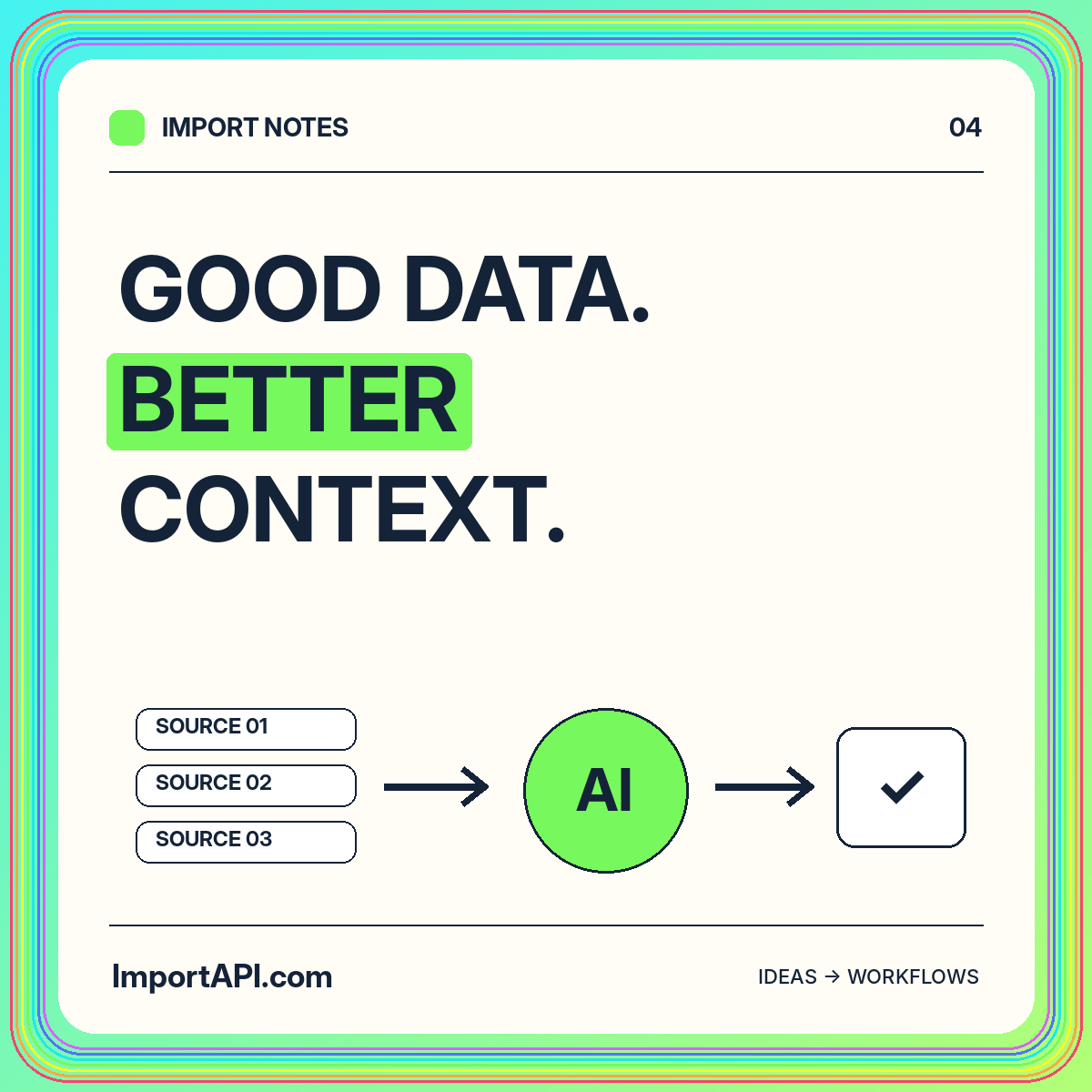
Better context starts before the prompt.
Prepare a knowledge collection with meaningful chunks, source lineage, permission boundaries, and evaluation grounded in real questions.
Read the guideGOOD DATA. GREAT POSSIBILITIES.
Explore the ingestion decisions behind an AI knowledge collection: reviewed extraction, useful chunks, source lineage, access boundaries, and real evaluation questions.
Identify the tasks your collection should support and the cases it should not answer. Assemble representative questions with expected source sections. Inspect extracted documents before turning them into retrieval units.
A search index cannot repair an instruction whose table labels or prerequisites disappeared during extraction. Make source quality visible before tuning retrieval.
Use section boundaries and complete ideas as candidates for chunking. Test size and overlap against the actual material rather than assuming one recipe fits every document. Attach source identity, revision, and necessary access attributes to each derived unit.
Keep embedding inputs distinct from stored application records. Record transformation and embedding configurations so changed processing can be evaluated and reproduced.
Inspect retrieved passages before judging generated answers. Check whether the expected source is present, current, and accessible to the requesting user. Imported text remains evidence, not authorization to change application instructions or tool permissions.
Plan how source edits, revoked access, and deletions propagate to derived records and caches. A complete lifecycle includes removing obsolete chunks, not only adding new ones.
Use a small, representative source and write down the expected result for one accepted record, one correction, and one repeated attempt. Keep the original values and the destination expectations visible throughout the review.
Use the format guides for source decisions and the local quickstart to see a simple mapping in action.
Prepare a knowledge collection with meaningful chunks, source lineage, permission boundaries, and evaluation grounded in real questions.
Read the guideBuild a document import that preserves headings, handles uncertain extraction, and connects useful text to its original source and revision.
Read the guideImport prompts as maintained artifacts with explicit roles, declared variables, review history, repeatable tests, and a rollback path.
Read the guide