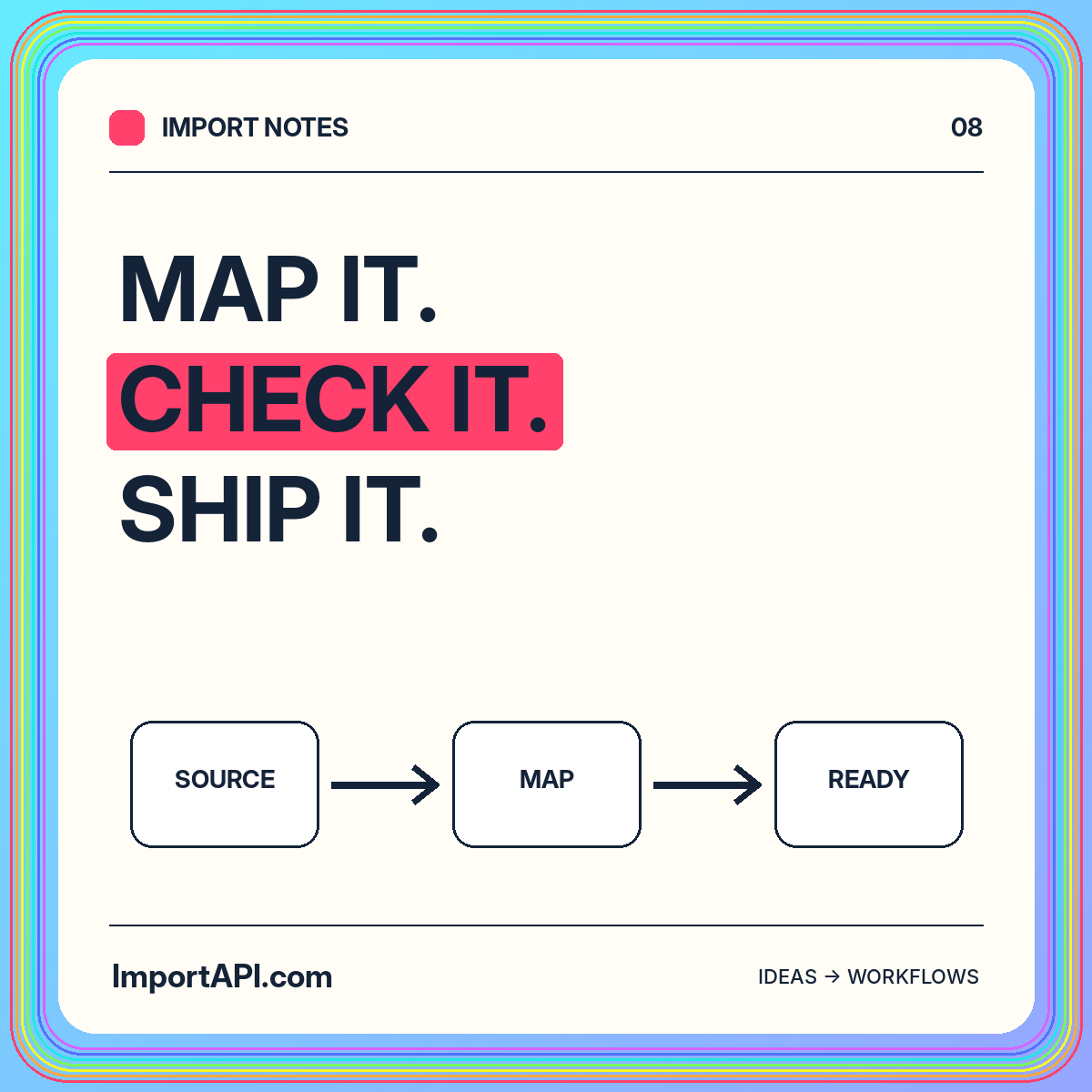
Field mapping and validation solve different problems. Mapping decides how a source value becomes a destination value. Validation decides whether the resulting value satisfies the destination's requirements. Combining both into a single opaque transformation makes failures difficult to explain. Keeping them distinct gives operators a clearer preview and gives developers smaller, more reliable tests.
Imagine importing a membership directory into an application that expects member_id, full_name, country, and active. The source instead contains Member Number, Name, Country Name, and Membership Status. A good mapping does more than rename those columns. It defines which conversions are permitted, which assumptions require review, and which source values cannot be accepted. This guide proposes a practical way to make that agreement explicit.
Start with a destination contract
Write the destination fields before looking for automatic matches. For each field, specify its type, whether it is required, and any relevant limits. Clarify whether absent, empty, and null values have different meanings. In the membership example, an absent active field might mean no change during an update, while false explicitly disables a membership. Treating both states as the same would erase an important distinction.
Include the fields you intentionally do not accept. An import boundary should not expose every property on an internal database record. Administrative flags and ownership identifiers need their own authorization rules. A small, deliberate destination contract also gives teams a shared vocabulary when source exports use inconsistent labels.
Build a mapping that can be reviewed
Represent each mapping as a source field, a destination field, and a named transformation. For example, Membership Status might map to active through an explicit lookup that accepts Current and Paused. Avoid a vague truthiness conversion where every nonempty string becomes true. Such a rule would make the word Inactive behave very differently from the operator's expectation.
Show the mapping alongside representative source values. Automatic suggestions can save time, but make them proposals rather than invisible decisions. Name similarity is not sufficient evidence that two fields have the same meaning. A field called Account may refer to an organization, a customer number, or a financial category depending on the source system.
Normalize carefully and keep evidence
Normalization is useful when it removes accidental variation without changing intended meaning. Trimming surrounding whitespace from a country code may be appropriate. Rewriting a person's name, changing punctuation in an identifier, or discarding accents is a different kind of decision. Do not apply broad cleanup rules to every string just because they make comparison easier.
Retain a source reference and the mapping version for each processing result. Where privacy requirements permit, keep a restricted original-value record for disputed transformations. The application log does not need to contain the entire directory. A job identifier and a row reference can connect an error to protected source material without spreading personal information across operational systems.
Use schema validation for structural expectations
The JSON Schema object reference explains properties, required fields, and the treatment of additional properties. In particular, listing a property does not by itself make it required. An explicit required list expresses that requirement. Those distinctions are useful when reviewing a machine-readable contract for mapped records.
Apply the contract to an example
For the membership example, define member_id as a nonempty string and active as a boolean. Decide whether unexpected fields should be rejected or ignored, and expose that decision to the producer. Schema validation helps describe record structure; it does not independently prove that a member exists, a country choice is appropriate for your business, or the caller has permission to change the record.
Keep business rules outside basic shape checks
A structurally valid record can still violate business policy. A member identifier may already belong to another organization. A new expiration date may precede a contractual start date. A category may be valid in the application generally but unavailable to this particular tenant. These checks require context that a basic field-type definition does not contain.
Organize validations by the data they need. Field-level checks can run against one normalized value. Record-level checks compare values within a row. Batch-level checks detect conflicts across source rows. Destination checks consult current application state. This organization helps explain why some errors appear immediately while others require a complete batch or a final precommit review.
Make transformations deterministic
A transformation is easier to test when the same input and configuration produce the same output. Avoid conversions that silently depend on the machine's locale, current date, or a changing external lookup. When such context is necessary, capture it as part of the job configuration. A replay should not unexpectedly reinterpret last month's source file.
Consider a country mapping table maintained by the importing team. Record the table version used for the job. If a new alias is added later, that change should not retroactively alter the explanation of earlier imports. Determinism is not only a developer convenience; it makes support conversations and audit trails far more understandable.
Design errors for the person fixing them
Return a stable code, source location, destination field, and a helpful explanation. A message such as country_not_supported is useful to software, while a sentence explaining the accepted country representation is useful to a person. Supply both. Avoid a generic record_invalid response that forces the operator to guess which of several transformations failed.
Show only the information needed to correct the issue. A report about a missing member identifier does not need to repeat private notes from another column. Where the same cause affects many records, provide a summary and a way to identify affected rows. Hundreds of identical alerts can conceal the single mapping mistake responsible for them.
Version mappings and schemas together
A source field can change meaning without changing its name. A destination can introduce a new required field. Store a version for both the mapping and the destination contract so a completed job has an interpretable history. The version identifiers need not be complicated, but they must refer to configurations that can actually be retrieved or reconstructed.
Review compatibility deliberately. Adding an optional destination field may preserve old imports, while changing the interpretation of blank values can alter results significantly. Keep fixtures for older mappings when they remain supported. A successful test of the latest mapping does not prove that recurring jobs using a previous configuration still behave correctly.
Test the preview and the final write
A preview should exercise the same mapping and validation rules used by the final processing path. Otherwise, it can reassure the user about a result that will never actually occur. Differences caused by changing destination state still need handling: another process might create a member after preview but before commit.
Write tests for an unchanged repeat, a corrected rejected row, and a conflicting update. For each case, specify the expected record count and destination state. Include a test in which an optional field is omitted and another in which it is explicitly empty. The batch reliability guide connects those outcomes to safe retry behavior.
Review one example from beginning to end
Take a source row with a zero-prefixed member number, surrounding whitespace in the country field, and an unfamiliar membership status. Trace it through every stage. The identifier should retain its intended representation. The approved whitespace rule should be visible. The unknown status should produce a correction request rather than an invented interpretation.
Ask a person outside the implementation team to explain the result using only the preview and error report. Any point requiring an undocumented explanation is a candidate for clearer guidance. This small walkthrough is often more revealing than a demonstration containing only perfect source records. It tests whether the contract is understandable, not just whether the code executes.
Conclusion: make every conversion explainable
A robust import workflow treats mapping as a visible agreement and validation as a set of specific checks. Preserve meaning, keep important context, and describe failures at the level where they occurred. Automation is most useful when it handles known cases predictably and asks for help on genuinely ambiguous ones.
Use the developer reference to explore an example record envelope, and the data import page to connect these rules to a complete workflow. Before adding more transformations, make sure an operator can explain one accepted record and one rejected record without reading the implementation.